


When speakers discuss time and location, three little prepositions often come up: in, on, and at. But the three can be very confusing! So how can we make sure that we are using them correctly?
Let’s start by looking at how we talk about time and location. English speakers use IN to refer to a general, longer period, such as weeks, months, years, decades, or centuries as well as with countries and cities. For example, we say “in 2 weeks”, “in April,” “in 2015”, “in 90’s”, or “in the 21st century”, “in Peru”, and “in Lima.”
Take a look at this image:
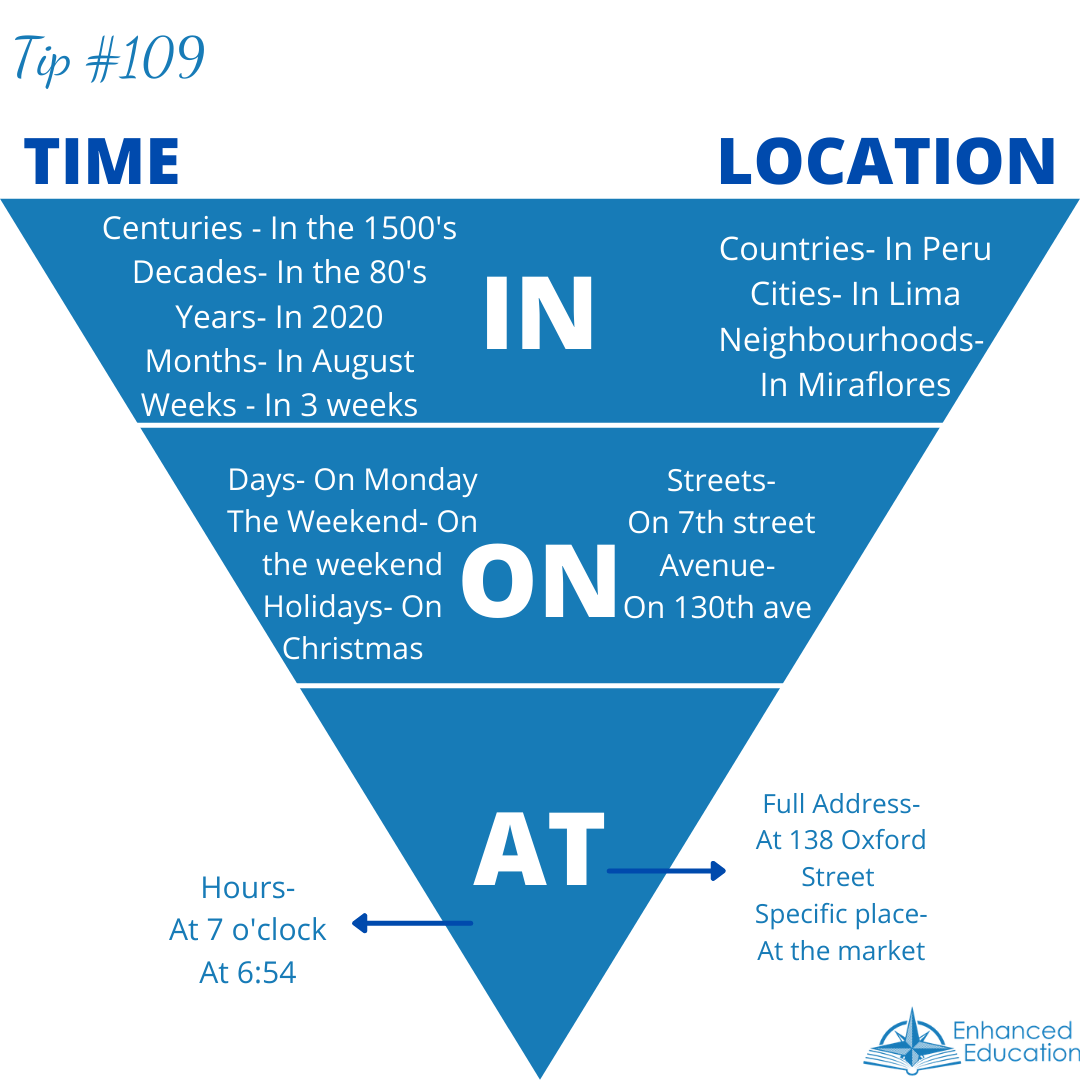
As you can see in the image above, using IN is meant for more general time and place to AT which is much more specific.
We use IN:
- with parts of the day:
I’ll come and see you in the forenoon for a cup of coffee, fine?
- with months:
We normally go camping in March.
- with years:
This building was built in 1835.
- with seasons:
The garden is astonishing in the spring when all the flowers bloom.
- with long periods:
The population of China increased rapidly in the nineteenth century.
- with the country name:
I lived in Peru. I love my country.
- with city name:
I lived in Lima. Lima is a beautiful city.
We use ON:
Moving to shorter, more specific periods and addresses, we use “ON” to talk about particular days, dates, holidays, and Addresses.
- to refer to a position on any surface:
I know I left my tea on the table.
- to specify a position along a road, river or by the sea or by a lake:
Dublin is on the east coast of Ireland.
- to talk about a level in a building:
They live on the 15th floor!
- to talk about being physically on public transport:
I was on the subway when she out of mind.
For the most specific times and locations, and holidays without the word “day,” we use “AT”.
We use AT:
- to refer to a location which we see as a point:
I was sitting at my desk.
- To talk about locations at companies or workplace areas?
How many people are working at Microsoft?
- to refer to enterprises that involve a group of people:
Were you at Jackson’s party?
- with school/college/university:
She always did well at school.
- to refer to an address:
They once lived at number 12 North Street.
- to talk about public places where we get services
I can’t meet at four. I’ll be at the hospital until five.
- to refer to most shops:
Look what I bought at the butcher’s today.
So what now?
Now it’s time to practice, of course! Pretend to make plans with someone and the two of you are trying to figure out when and where. Make sure to try to use as many as you can for full practice.
Take a look at these examples:
Hey! Let’s get together this week, I think I’m free ON Wednesday. I think the Italian restaurant ON dos de mayo opens AT 8 pm. Meet me ON 145th Street AT 7:30 pm and we can go there together. I’m so excited! I haven’t been to that restaurant IN years!
I would love to get together this week! I’ll be busy ON Easter with my family, but I’ll have time the next day! Let’s say we can meet AT 10 am IN Miraflores?
I’ll be IN New York ON the weekend! I would love to meet up with you! I haven’t seen you IN six weeks!
Alright…
So are you feeling more confident in using these prepositions? Let me know! The best and only way to get good at them is to practice them.
Good luck!
Teacher Dawn


